Thomas Jefferson
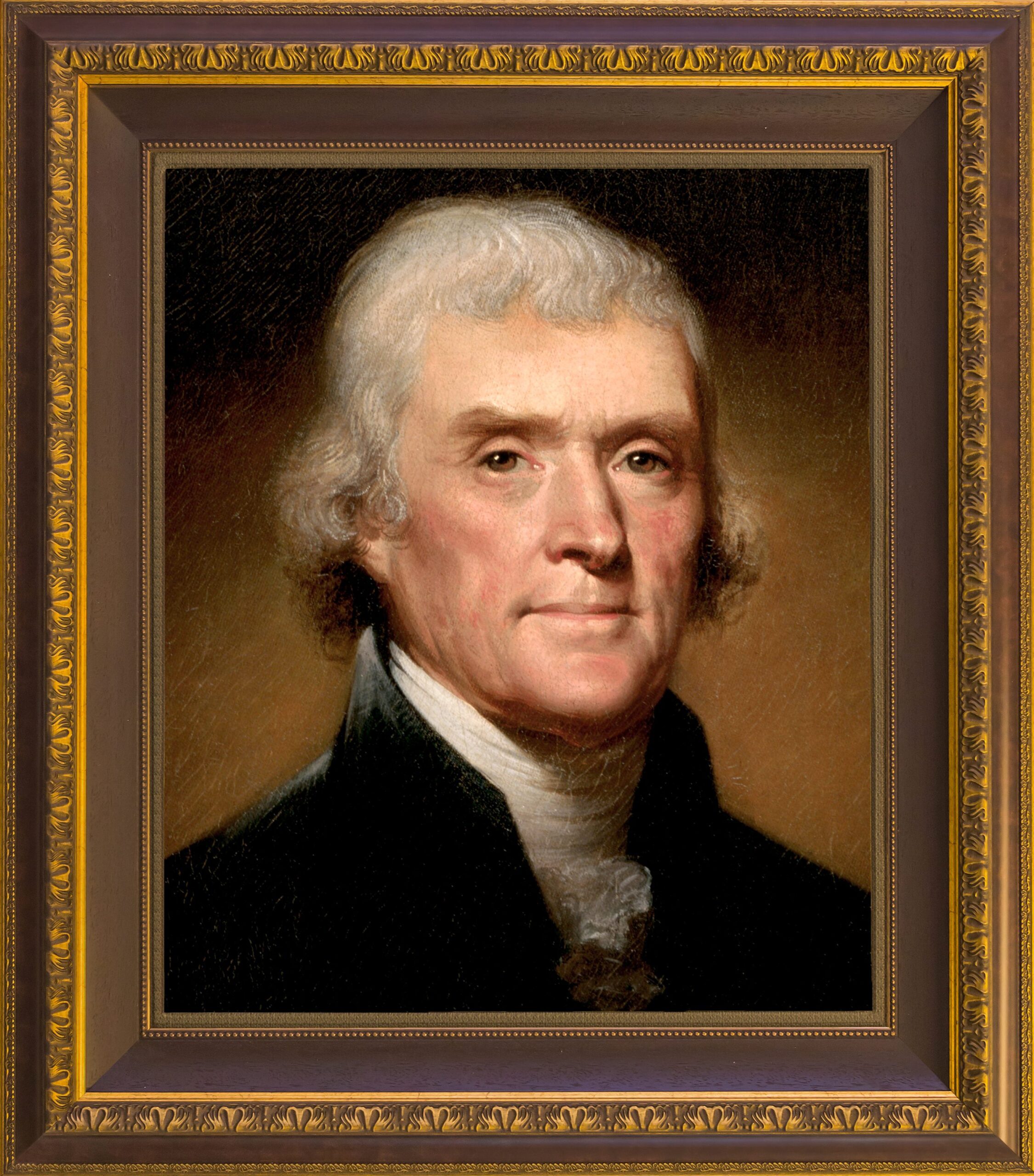
- The man who wrote that all men are created equal — and drafted the Declaration of Independence.
- The third President of the United States, who doubled the size of the nation by purchasing Louisiana.
- An architect and founder of a university, self-taught from books — he believed knowledge is power.
- And the enslaver of more than 600 people over his lifetime — including his own children with Sally Hemings.
One man, four faces: the politician who founded a nation, the visionary who built and dreamed, the tender family man — and the enslaver whose household included his own children. Every event below wears at least one of these faces; many wear several at once.
Early Life
Born at Shadwell, Virginia
April 13. Thomas is the third of ten children of Peter Jefferson, a planter and surveyor, and Jane Randolph.
A boy on the little mountain
Growing up at Shadwell, he loves to roam and linger on the small mountain nearby. He will one day name it Monticello — “little mountain” — and spend his whole life building on it.
Loses his father — and inherits a family
Peter Jefferson dies. Thomas is fourteen — some tellings say thirteen. Though he is the third child, he is the eldest son, and as the first boy he becomes heir to the largest share of his father's estate: the Rivanna lands that hold the little mountain, and about thirty of the roughly sixty enslaved people his father owned. He is now, in effect, the head of the family's holdings — though he will not take full legal control until he comes of age at twenty-one. The loss pushes him toward books and self-discipline.
Comes of age — full control of the land and its people
Turning 21, he takes full legal possession of his inheritance — the beloved mountain and the enslaved people who work it. His two identities — builder of dreams and enslaver — were handed to him in the same estate.
Revolution & Young Family
First Monticello rises
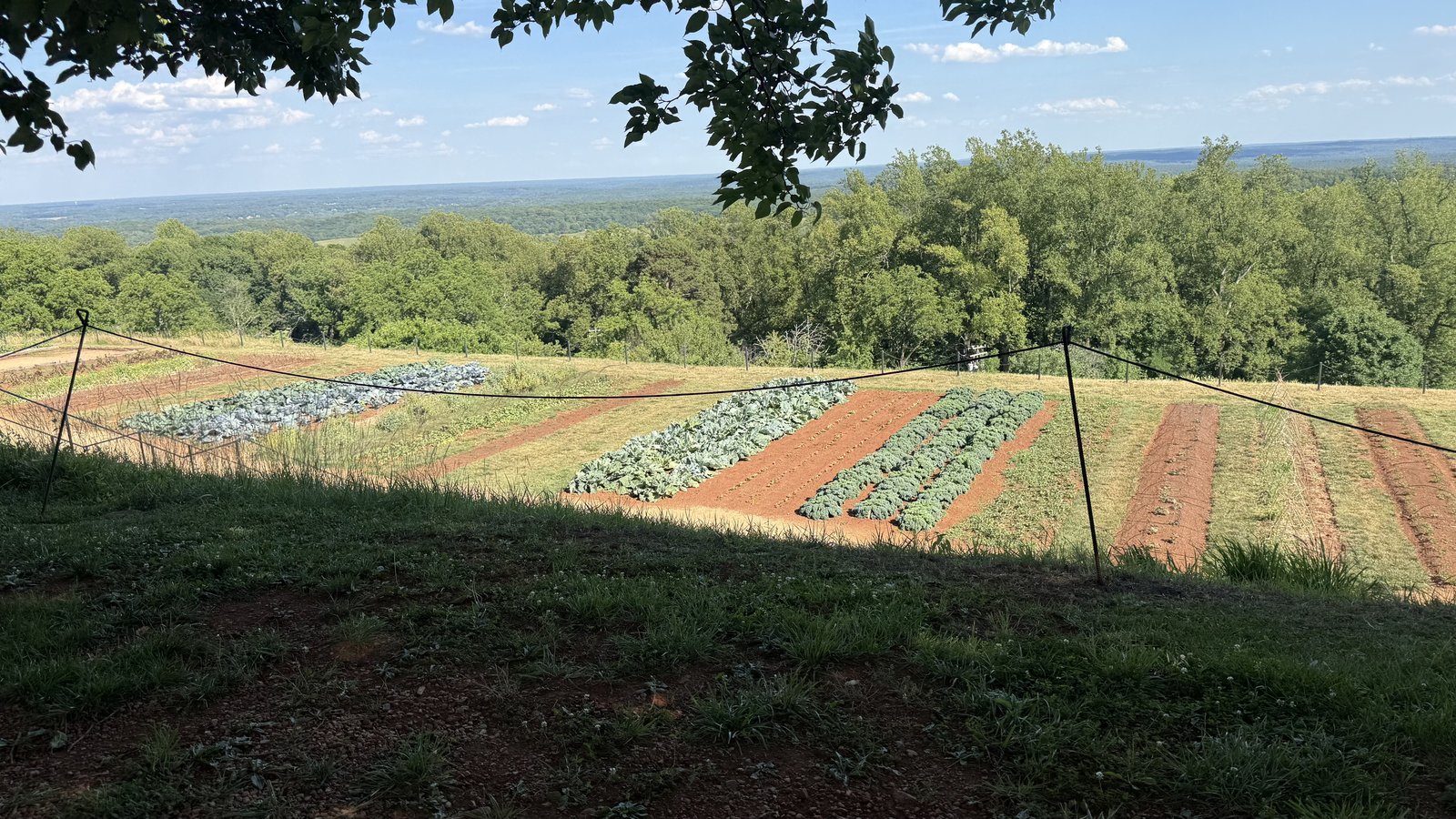
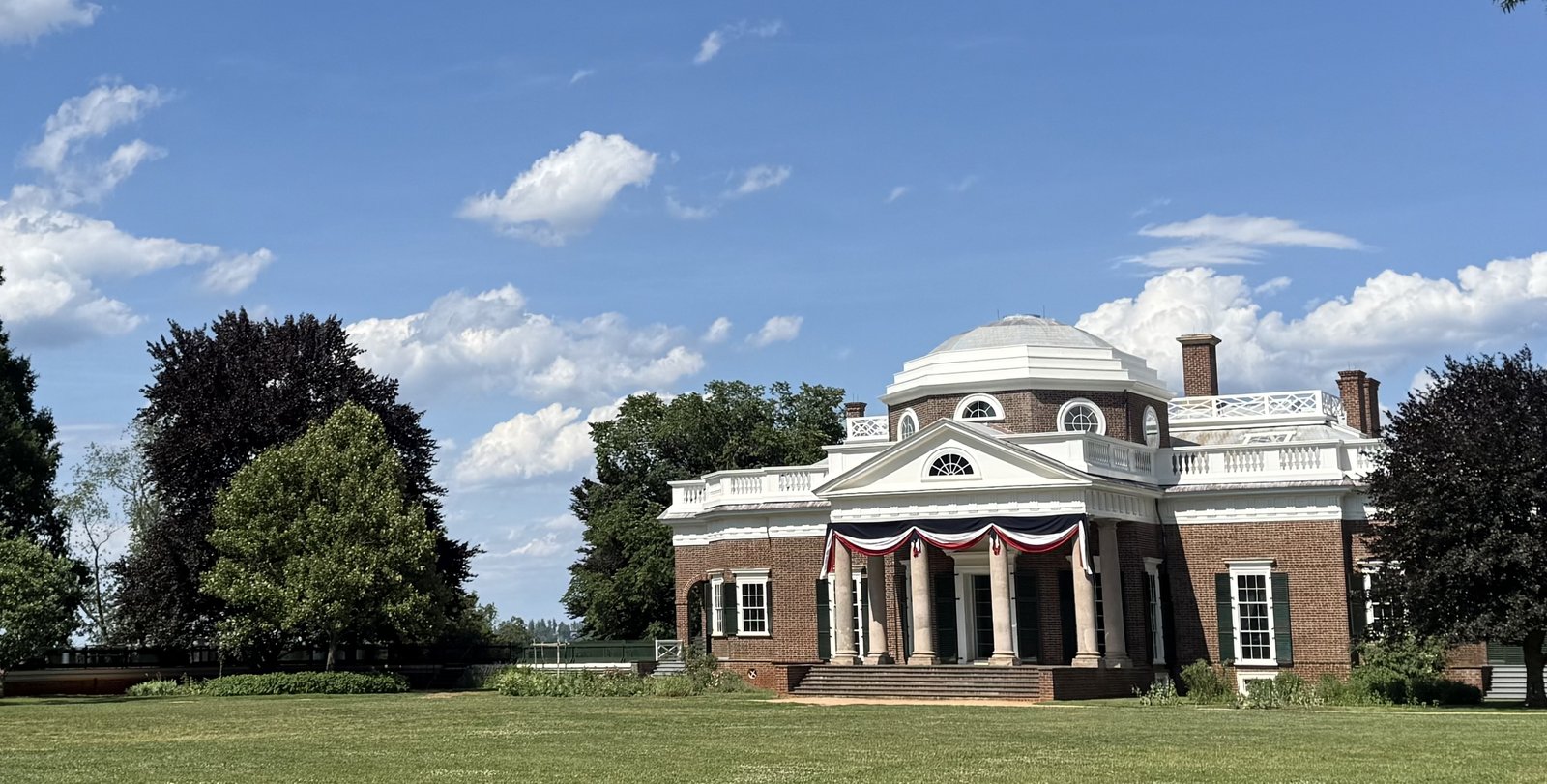
He levels the mountaintop and begins building his house to his own design — almost unheard of for an amateur. In 1770 he moves into the tiny South Pavilion while construction continues around him.
Becomes a representative of Virginia
Elected to the House of Burgesses at 26 — the start of four decades in public life.
Marries Martha
January 1. He weds the young widow Martha Wayles Skelton; they share music, books, and a deep affection. That September their first child, Martha “Patsy,” is born.
The Hemings family comes to Monticello
When his father-in-law John Wayles dies, Jefferson inherits 135 enslaved people — among them Elizabeth Hemings and her children. The infant Sally Hemings is Wayles’s own daughter: his wife Martha’s enslaved half-sister, brought into the household as property.
Drafts the Declaration of Independence
At 33 he writes the sentence that will outlive everything else: all men are created equal. He writes it as the owner of roughly two hundred enslaved people — the contradiction at the center of his life, and of the new nation’s.
Governor of Virginia
Leads his state through the darkest years of the Revolutionary War.
Martha dies — and a promise is made
Weakened after the birth of her last child, Martha dies in September — though some accounts point less to childbirth itself than to a longer illness that had been wearing her down for years. On her deathbed he promises her he will never marry again — and he never does. He burns their letters and shuts himself in his room; even as friends and fellow founders urge him back to public life, he refuses for weeks, unable to work at all, then rides the hills around Monticello for hours in silent grief.
Little Lucy dies
His two-year-old daughter Lucy dies of whooping cough while he is abroad. Grief-stricken, he sends for his surviving daughter Polly to join him in France — a summons that will change Sally Hemings’s life.
Paris
Minister to France
He crosses the Atlantic to represent the new United States in Paris, immersing himself in Enlightenment science, food, wine, and ideas.
Falls in love with architecture
He studies Paris’s neoclassical buildings — he confessed to gazing at the domed Hôtel de Salm for hours. The forms he absorbs here will drive him to tear apart and reimagine Monticello.
A French education — by order
The micromanager abroad: he has his enslaved cook James Hemings trained in French cuisine at his expense, importing recipes and techniques he will later dictate into Monticello’s kitchen. Even his household’s palate is designed by him. Freed in 1796 — only after training his brother Peter to replace him — James died a free man in Baltimore in 1801, reportedly by suicide.
Sally Hemings arrives — and is inoculated
Fourteen-year-old Sally escorts Polly to Paris. Ever the man of science, Jefferson pays to have her inoculated against smallpox — a small dose of the virus given deliberately to build immunity, cutting-edge medicine for the age.
A free person persuaded back into slavery
Under French law, Sally is free on French soil and could simply stay. Sixteen and pregnant — by Jefferson, according to her son Madison’s account — she extracts a bargain: she returns to Virginia as his slave in exchange for privileges and his promise to free her children at 21. She will bear six of his children; four survive to adulthood.
Building a Nation, Rebuilding a House
Secretary of State
First Secretary of State under Washington, sparring with Hamilton over what kind of country America should be.
A visitor’s shock
The French traveler Volney, visiting Monticello, is startled to see enslaved people as light-skinned as himself — living evidence of generations of children fathered across the color line, held in bondage by their own relatives.
Tears down and rebuilds Monticello
Armed with his Paris notebooks, he doubles the house and crowns it with America’s most famous dome. He micromanages everything — the kitchen’s design, French recipes, the smoke room, the wine cellar with its hidden dumbwaiters — a machine for gracious living, run entirely on enslaved labor. The endless rebuilding piles up a debt he will never escape.
Vice President under John Adams
Serves under his friend-turned-rival, John Adams — a friendship that will fracture, heal in old age through letters, and end on the same extraordinary day.
Third President of the United States
Two terms. He doubles the nation with the Louisiana Purchase and sends Lewis and Clark into the unknown.
The scandal breaks
Journalist James Callender publishes the story of the president and his enslaved “concubine,” Sally. Jefferson never responds — not once, for the rest of his life. His acknowledged family denies it; his unacknowledged family holds it as a sacred truth for generations, until the world catches up in 1998.
The entrance hall becomes a museum
The born entertainer turns Monticello’s entrance hall into a cabinet of curiosities — mastodon bones, maps, Native American artifacts from Lewis and Clark — so that every visitor kept waiting for him learns something new while they wait.
Polly dies
His daughter Mary “Polly” dies at 25, in the middle of his presidency. He is devastated and can barely function for a time. Of his six children with Martha, only Patsy now survives.
The Sage of Monticello
“I cannot live without books”
After the British burn the Capitol and its library in 1814, he sells Congress his own 6,487 volumes to rebuild it — then writes to John Adams, “I cannot live without books,” and immediately starts collecting again.
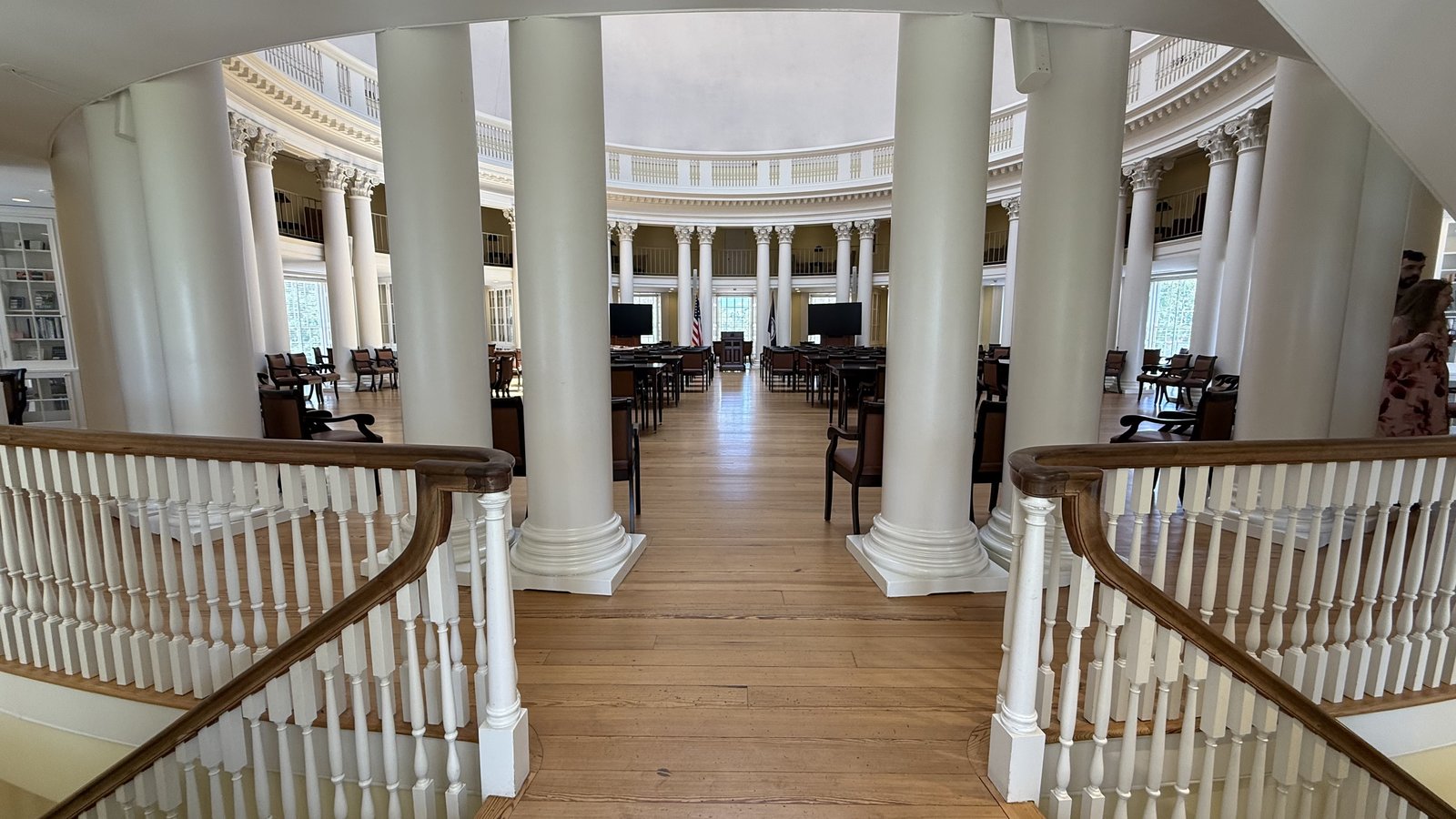
Designs the University of Virginia
In his seventies he designs the Academical Village and its crown, the Rotunda — placing a library, not a chapel, at the heart of a university. His conviction, still honored in the Rotunda today: a library is not a place to linger, but everyone must have access to books and knowledge.
Two of his children walk free
Beverly and Harriet Hemings — his children with Sally — are quietly allowed to leave Monticello, keeping the Paris promise. Both were light-skinned enough to pass as white — more so, by all accounts, than most of his other enslaved children — and that is exactly what let them disappear. Raised with training in skilled trades and music, both cross into white society and vanish from the record.
Dies on the Fourth of July
He dies at Monticello on July 4 — fifty years to the day after the Declaration — asking near the end, Is it the Fourth? Hours later in Massachusetts, John Adams dies too, whispering Thomas Jefferson survives, not knowing his old friend has gone before him. Neither man ever learned the other had died: in 1826 news still traveled only as fast as a letter on horseback, and word of Jefferson's death was days away from reaching Massachusetts.
The final accounting
He dies about $107,000 in debt — several million today — much of it from the endless rebuilding of Monticello. Of the 600+ people he enslaved over his lifetime, he freed only ten, every one of them a Hemings; his will names five men, each trained in a trade that lets him live free. In two auctions, 1827 and 1829, about 130 people — advertised as “130 valuable negroes” — are sold to settle the debts: husbands separated from wives, children as young as eight sold away from their parents. Sally Hemings is never formally freed; his daughter gives her “her time,” and she lives out her days in Charlottesville with her sons Madison and Eston. The location of her grave is unknown.
After Jefferson
The Rotunda burns
Fire guts Jefferson's library-temple; students rush in to save the books. The interior is destroyed — but the massive brick shell stands.
Monticello becomes a museum
The Thomas Jefferson Foundation forms as a nonprofit to purchase Monticello and open it to the public as a historic site. The entrance hall he designed to teach his waiting guests now teaches millions of visitors — and, in time, tells the Hemings family's story alongside his own.
UNESCO World Heritage
Monticello and the University of Virginia — including the Rotunda — are inscribed together as a World Heritage Site: one architect, honored for a house and a university.
Restoration reveals hidden structure
A major renovation uncovers original construction concealed for nearly two centuries — including an 1820s chemical hearth sealed inside a wall — and lays bare the solid masonry bones that helped the building survive the 1895 fire. Even hidden, Jefferson’s engineering held.
Books & media
 The Hemingses of Monticello: An American FamilyThe Hemingses of Monticello: An American Family — Annette Gordon-Reed · Buy on Amazon
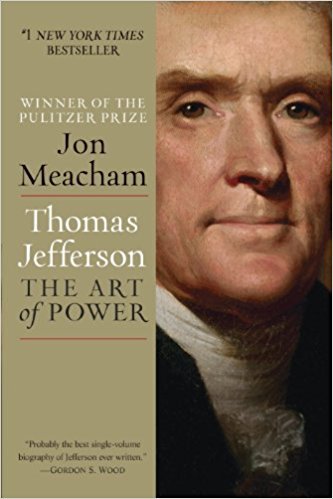 Thomas Jefferson: The Art of PowerThomas Jefferson: The Art of Power — Jon Meacham · Buy on Amazon
As an Amazon Associate, I earn from qualifying purchases.