Stowe
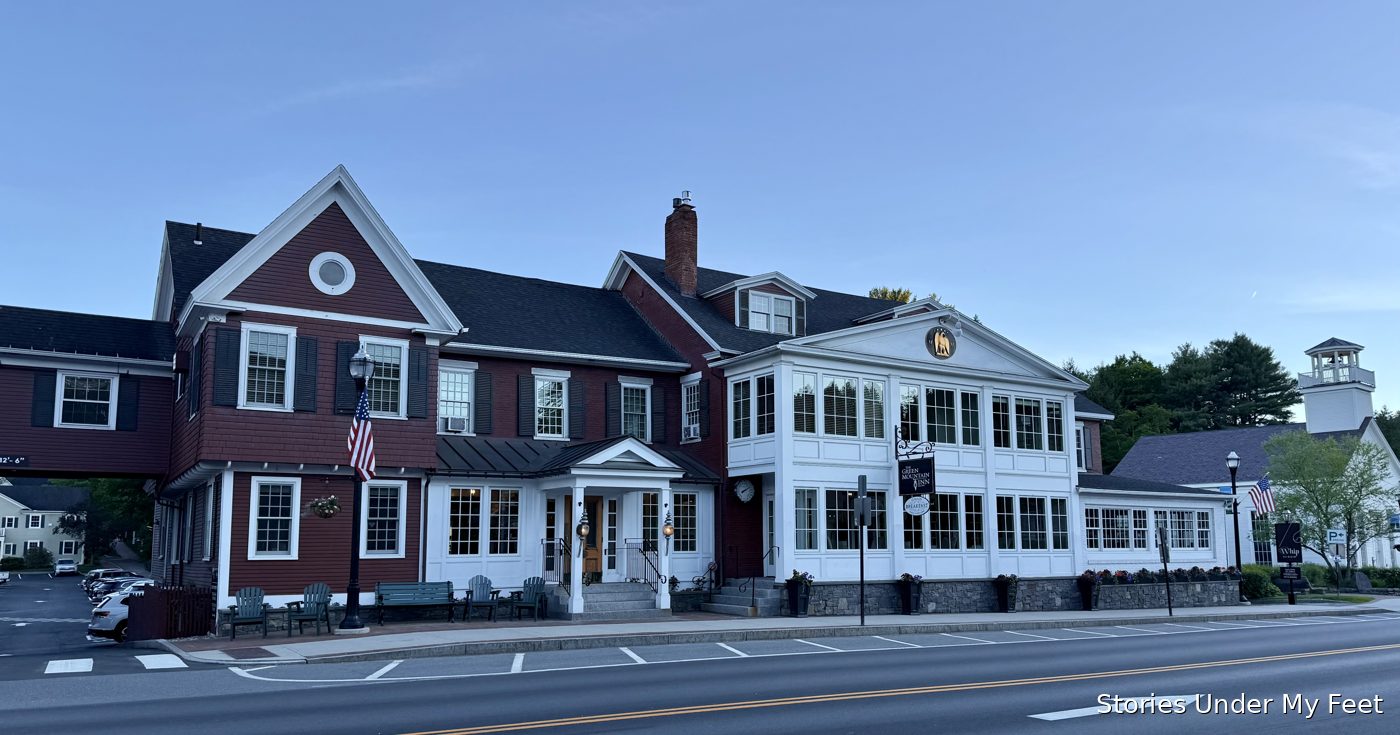
I came to Stowe knowing almost nothing about it — only that the Trapp Family Lodge, the real home of the Sound of Music family, was here (it has its own entry). Everything else I learned by accident, mostly from the hotel I happened to book. It turns out this is a ski town with a long history, and I only found that out because I stayed somewhere old.
I'd picked the Green Mountain Inn almost entirely on price — it had a spa and a sauna, and it looked charming in the photos, so that was enough for me. What I didn't expect was that it would be a genuinely historical hotel. Old newspaper clippings, photographs, and framed write-ups of the inn's history were hung all through the halls, so I ended up reading my way through more than a century of Stowe just walking to my room. It was a lovely place to stay. Even though the sauna and spa aren't fed by natural hot springs — there aren't any here — I still managed to relax completely and get some real rest.
The town itself is small and cute, with such a warm atmosphere. Wood, garnet red, white trimmed with lacy detailing, a fire pit here and there — classical, and a little nostalgic, the kind of cute that isn't trying too hard. And it's not just one street; that feeling covers the whole place. Honestly I'd rather call it a village than a town. Such a cute little village.
The history hanging on the walls
Reading the framed panels at the inn — and looking a few things up afterward — the story goes back further than I'd guessed. The building started in 1833 as a private residence built by Peter C. Lovejoy. Around the 1840s it passed to Stillman Churchill, who turned it into a hotel, adding brick wings and a dance hall and calling it the Mansfield House. Churchill was apparently the first person to advertise Stowe as a mountain resort at all, though it cost him the hotel in debt. Over the decades it changed hands and names more than once — Mansfield House, the Brick Hotel — before finally settling on the Green Mountain Inn by the 1890s.
The town nearly lost its momentum when the enormous Mount Mansfield Hotel next door burned down in 1889, but the inn itself endured. It got a second life in 1926 when the Bodman family bought and reopened it, and then truly came back with the rise of skiing. One detail I loved: Stowe voted itself "dry" long after Prohibition ended, so the inn couldn't serve a drink until the town finally went "wet" in 1950 — which is when the Whip Bar, named for the antique buggy whips collected on its walls, first opened. The Gameroff family bought the property in 1982 and have been renovating it almost every year since, so today it's grown to around 100-plus rooms across several connected buildings while somehow still feeling like the old place in the photographs. It's also listed on the National Register of Historic Places, and apparently both President Chester A. Arthur and President Gerald Ford stayed here.
The apple cider I cannot stop thinking about
Normally I don't eat apples much — I'll drink apple juice, but that's about it. Here, though, apple cider was everywhere, and since it's the famous local thing I felt I simply had to try it. I grabbed a half-gallon at a market without even checking the details. It was amazing. Believe it or not, I finished the entire jug in a single day — that same night, in something like three or four hours. I still can't quite believe it happened to me. That's the level of shockingly delicious it was. Honestly, I want a glass right now.
The best of it came from Cold Hollow Cider Mill, just down Route 100 toward Waterbury, where they still press their cider on a century-old rack-and-cloth press. I want it in LA.